
The Slower Hand: What a Creative Note Really Is
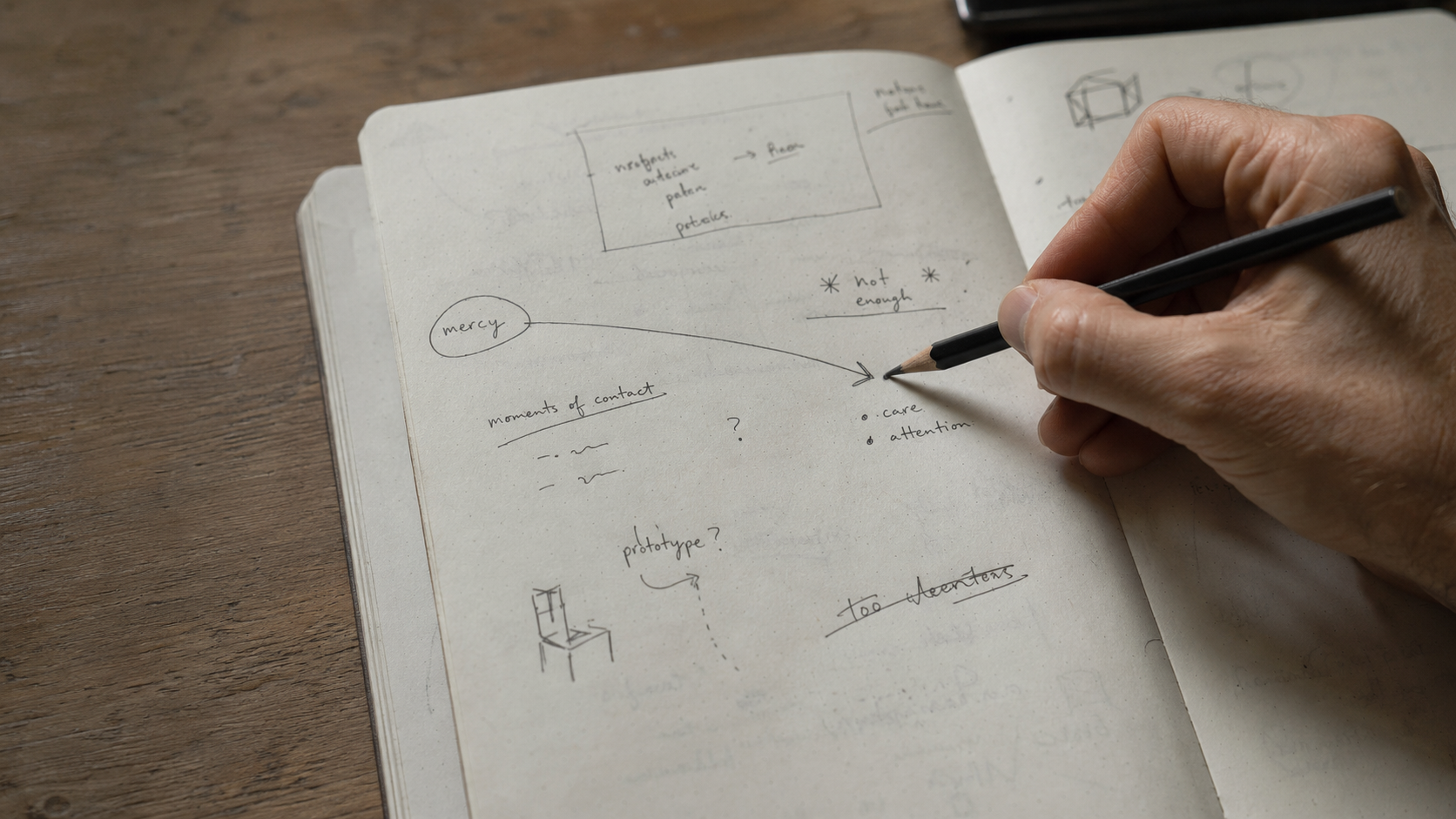
Otwórz notatnik kogoś, kto naprawdę go używa, a nie tylko nosi. Zobaczysz krzywy prostokąt z dopiskiem „światło stąd”, strzałkę prowadzącą donikąd, trzy słowa w kółku, przekreślone zdanie i datę wpisaną z rozpędu w niewłaściwym miejscu. To nie wygląda jak notatka. To wygląda jak drobna katastrofa.
I właśnie to jest kreatywna notatka.
Bo notatka twórcza nie jest zapisem. Zapis odtwarza to, co już było. Notatka twórcza zmienia to, co myślisz, w trakcie zapisywania – i to jedyne kryterium, które naprawdę ją definiuje. Jeśli po zamknięciu zeszytu wiesz dokładnie tyle samo, co przed jego otwarciem, nie zrobiłeś notatki. Zrobiłeś kopię.
Skórzany notes bywa przeszkodą
Krąży przekonanie, że twórcza notatka mieszka w pięknym przedmiocie: gruby papier, gumka, zaokrąglone rogi. Nie znam badań, które porównywałyby zawartość notesu za dwieście złotych z zawartością zeszytu w kratkę za trzy. Podejrzewam, że nikt takich nie prowadził. Znam natomiast badania nad tym, co się dzieje, gdy człowiek uzna, że jakaś czynność jest kosztowna i że mu nie wyjdzie.
W 2024 roku Eidman i Fiorella sprawdzili, czy studenci sami z siebie rysują, ucząc się z tekstu o układzie oddechowym. W grupie, która miała wolny wybór, na dwadzieścia sześć osób tylko trzy wykonały choć jeden rysunek w całej, dziesięcioczęściowej lekcji. Nawet gdy do wyboru zostawiono im wyłącznie rysunek albo streszczenie, w osiemdziesięciu czterech procentach przypadków wybierali streszczenie. Powód okazał się prosty i mierzalny: oczekiwanie sukcesu przy rysowaniu było znacznie niższe niż przy pisaniu, a odczuwany koszt wyższy.
Piękny notes działa dokładnie w tę stronę. Podnosi cenę pierwszego śladu. Im droższy przedmiot, tym mocniejsze poczucie, że pierwsza kreska powinna być dobra – a kreatywna notatka nigdy nie zaczyna się od dobrej kreski. Zaczyna się od kreski próbnej. Dlatego zeszyty ludzi, którzy naprawdę myślą na papierze, wyglądają na zniszczone już w trzecim tygodniu.
To oczywiście mój pogląd, nie wynik eksperymentu. Ale wynik eksperymentu mówi, że barierą nie jest brak talentu, tylko przekonanie o koszcie.
Bazgroły to dwie zupełnie różne rzeczy
Tu trzeba rozdzielić dwa zjawiska, które w popularnych tekstach zlewają się w jedno.
Pierwsze to bazgranie w sensie zajmowania ręki: cieniowanie kółek na marginesie, kratkowanie, powtarzalny wzorek. Sławę zrobiło mu badanie Jackie Andrade, w którym czterdzieści osób słuchało nudnej wiadomości telefonicznej. Ci, którzy w tym czasie zamalowywali wydrukowane kształty, przypomnieli sobie o dwadzieścia dziewięć procent więcej informacji. Liczba poszła w świat i żyje własnym życiem – rzadko z dopiskiem, że dotyczyła czterdziestu osób, jednego eksperymentu i różnicy rzędu niecałych dwóch pozycji na liście.
W 2024 roku Spencer-Mueller i Fenske powtórzyli ten pomysł na dwustu dwudziestu dwóch osobach. W wersji bliskiej oryginałowi nie znaleźli żadnej różnicy w zapamiętywaniu. W wersji z prawdziwym, piętnastominutowym wykładem o greckich wiekach ciemnych najlepiej wypadli ci, którzy robili notatki – lepiej niż bazgrzący w sposób ustrukturyzowany, lepiej niż bazgrzący swobodnie i lepiej niż ci, którzy tylko słuchali. Nuda rosła w każdej grupie tak samo.
Uczciwa odpowiedź brzmi więc: bazgranie dla zajęcia ręki nie ma dobrego oparcia w dowodach, a to, co ma, jest słabe i nie broni się w powtórzeniach.
Drugie zjawisko to rysowanie treści – czyli próba narysowania tego, o czym właśnie myślisz. To zupełnie inna liga. Wammes, Meade i Fernandes w siedmiu eksperymentach pokazali, że słowa narysowane wracają w swobodnym przypominaniu znacznie lepiej niż słowa zapisane; autorzy mówili o różnicy ponaddwukrotnej. Efekt przetrwał, gdy skrócono czas i wydłużono listę. Bobek i Tversky poszli dalej: uczniowie, którzy rysowali wyjaśnienie wiązań chemicznych, rozumieli je lepiej niż ci, którzy pisali wyjaśnienie słowne, a w teście odroczonym różnica była duża. Przy pompce rowerowej przewaga rysunku dotyczyła głównie osób o niższych zdolnościach przestrzennych.
Ale i tu należy się przypis. Huff i współpracownicy wykazali w 2024 roku, że przewaga rysunku w listach mieszanych jest zawyżona: mieszanie zadań podnosi wynik pozycji narysowanych i jednocześnie obniża wynik zapisanych obok nich. Sam efekt utrzymał się jednak także w listach jednorodnych, w których uczestnik albo tylko rysował, albo tylko pisał. W takim właśnie układzie Mykoniatis, Smith i Drake w 2025 roku efektu nie odtworzyli – za to o wyniku decydowały umiejętność rysowania, pojemność pamięci roboczej i wcześniejsza znajomość materiału. Efekt rysowania jest realny, ale jest zjawiskiem laboratoryjnym o wyraźnych warunkach brzegowych, a nie magią.
Bazgrolenie ma zatem sens dokładnie wtedy, kiedy przestaje być bazgroleniem, a staje się rysunkiem czegoś konkretnego.
„Nie umiem rysować”
To zdanie prawie zawsze znaczy coś innego, niż mówi. Znaczy: „nie umiem zrobić ładnego obrazka i wstyd mi go pokazać”.
Warto wtedy powiedzieć trzy rzeczy.
Po pierwsze, rysunek w notatniku nie jest obrazkiem. Jest schematem myśli. Ma być zrozumiały dla jednej osoby przez dwa tygodnie. Nikt go nie oceni, bo nikt go nie zobaczy. W badaniu Fernandes, Wammesa i Meade ani doświadczenie w rysowaniu, ani deklarowana żywość wyobraźni wzrokowej nie korelowały z korzyścią pamięciową; autorzy pisali wprost, że jakość rysunków bywała bardzo różna, a zysk porównywalny. Trzeba jednak dodać, że wspomniane badanie Mykoniatis z 2025 roku daje wynik przeciwny. Sprawa nie jest rozstrzygnięta, ale nie ma dziś podstaw, by zakładać, że trzeba umieć rysować, żeby coś z tego mieć.
Po drugie, rysowanie jest w dużej mierze problemem patrzenia, nie ręki. Cohen i Bennett metodą eliminacji wykluczyli decyzję, sprawność motoryczną i ocenę własnej pracy jako główne źródła błędu w rysunku z obserwacji i wskazali percepcję. Cohen i Jones pokazali później, że błędy wynikające ze stałości kształtu przewidują około osiemnastu procent zmienności dokładności rysunku – z zastrzeżeniem, że zespołowi McManusa nie udało się tego wyniku odtworzyć dwukrotnie, raz nawet z korelacją odwrotną do oczekiwanej, a metaanaliza łącząca oba zbiory danych daje korelację nieistotną. To dużo jak na jeden mechanizm i mało jak na całe wyjaśnienie – Rebecca Chamberlain przypomina zresztą, że rysowanie jest również umiejętnością motoryczną, mającą tyle wspólnego z tańcem i sportem, co z domenami percepcyjnymi w rodzaju szachów. Ale kierunek jest jasny: kto rysuje źle, ten najczęściej źle widzi, a nie źle trzyma ołówek.
Po trzecie, to się zmienia. Schlegel i współpracownicy przez jedenaście tygodni śledzili trzydziestu pięciu studentów: siedemnastu na wprowadzającym kursie rysunku i malarstwa, osiemnastu na chemii organicznej. Na starcie ich rysunki nie różniły się istotnie. Na końcu grupa artystyczna rysowała mierzalnie lepiej, a zmiany widoczne w mózgu dotyczyły struktur ruchowych i móżdżku, nie obszarów percepcyjnych. Jeden semestr. Ludzie dorośli. Kursu nikt im nie przydzielił losowo, wybrali go sami – ale na wejściu nie mieli przewagi.
Uczciwie: nie znaczy to, że każdy dojdzie do tego samego poziomu – Chamberlain zwraca uwagę, że część zdolności plastycznych ma komponent dziedziczny. Ale pytanie w notatniku nie brzmi „czy będę Leonardem”. Brzmi: „czy za dwa tygodnie zrozumiem, co narysowałem”.
Trzy mity linearnej notatki
Mit pierwszy: im więcej zapiszę, tym więcej mam. Ciekawe, że akurat ten wynik z całej dyskusji o klawiaturze i piórze jest najmocniejszy i najlepiej powtarzalny. Notatki pisane na komputerze zawierają wyraźnie więcej słów. W metaanalizie Flanigana i współpracowników efekt objętości okazał się duży: Hedges’ g na poziomie 0,92. Osobno mierzy się drugą różnicę: notatki z klawiatury zawierają więcej fraz przepisanych dosłownie za prowadzącym, co zgodnie zaobserwowali Mueller i Oppenheimer, Morehead oraz Urry. Nie wychodzi natomiast to, co miało z tego wynikać – o czym za chwilę. Ale sam mechanizm jest niepodważalny: klawiatura pozwala nadążyć, a nadążanie zwalnia z wybierania. Notatka, która niczego nie odrzuciła, niczego nie zrozumiała.
Mit drugi: notatka to archiwum. W replikacji Moreheada, Dunlosky’ego i Rawsona z 2019 roku grupa, która nie notowała w ogóle, wypadła na teście natychmiastowym tak samo jak obie grupy notujące. Z kolei w metaanalizie Flanigana i współpracowników z 2024 roku jedynym istotnym moderatorem przewagi pisma ręcznego okazała się możliwość powrotu do notatek. Bez powtórki przewaga pisma odręcznego zanika. Notatka, do której nigdy nie wracasz, jest w najlepszym razie ćwiczeniem uwagi. Wartość powstaje przy drugim czytaniu.
Mit trzeci: myśl ma kształt zdania. Nie ma. Zdanie jest jednowymiarowe i wymusza kolejność, której w myśli jeszcze nie ma. Kartka jest dwuwymiarowa, więc pozwala postawić dwie rzeczy obok siebie, zanim się wie, co je łączy. Scaife i Rogers nazwali to trzema mechanizmami: odciążeniem obliczeniowym, przekształceniem reprezentacji i ograniczaniem przez formę graficzną. Mniej uczenie: kartka pamięta za ciebie, pokazuje ten sam problem inaczej i nie pozwala narysować niemożliwego układu.
Dlaczego ręka – i dlaczego nie z powodu, który słyszysz najczęściej
Najgłośniejszym argumentem za pismem odręcznym stały się kolorowe obrazki z badań EEG. Warto wiedzieć, co dokładnie w nich zbadano.
W pracy Askvik, Van der Weel i Van der Meer z 2020 roku wzięło udział dwadzieścioro czworo osób: dwanaścioro dorosłych i dwanaścioro dwunastolatków. W pracy Van der Weela i Van der Meer z 2024 roku – trzydzieścioro sześcioro dorosłych. Zmierzono synchronizację i spójność fal mózgowych podczas pisania ręcznego i pisania na klawiaturze, a w pierwszej z tych prac także podczas rysowania. Nie zmierzono niczego, co dotyczyłoby uczenia się: nie było zapamiętywania, nie było testu, nie było przypominania. Uczestnicy wielokrotnie zapisywali znane sobie słowa. Wniosek o nauce jest wnioskiem przez analogię do innej literatury.
Nie jest to moja opinia. W styczniu 2025 roku w tym samym czasopiśmie ukazał się komentarz Pinet i Longcamp, w którym czytamy wprost, że protokół nie zawierał żadnego uczenia się, więc nie pozwala na wnioski o uczeniu się, a przenoszenie ich na dzieci w klasie „jest w najlepszym razie ryzykowne”. Zwracają też uwagę na sam warunek klawiaturowy: uczestnicy mieli pisać wyłącznie palcem wskazującym prawej ręki, co ma niewiele wspólnego z wprawnym pisaniem obiema rękami i mogło sztucznie obniżyć łączność zmierzoną po tej stronie porównania. Marieke Longcamp jest przy tym autorką klasycznych prac pokazujących przewagę pisma odręcznego przy nauce liter. To krytyka od środka, nie z zewnątrz.
Co więc zostaje? Zostaje coś skromniejszego i bardziej użytecznego.
Słynne badanie Mueller i Oppenheimera z 2014 roku, które ogłosiło, że pióro jest potężniejsze od klawiatury, nie potwierdziło się w replikacjach. Nie potwierdzili go ani Morehead ze współpracownikami w 2019 roku, ani Urry ze współpracownikami w 2021 roku, gdzie na stu czterdziestu dwóch uczestnikach przewagi pisma ręcznego w teście po prostu nie było. Metaanalizy nie są zgodne: jedne dają wynik zerowy, inne niewielki efekt na korzyść ręki – u Flanigana w 2024 roku Hedges’ g na poziomie 0,25. To realne, ale niewielkie.
Odręczne notowanie ma więc sens nie dlatego, że rozświetla mózg, tylko dlatego, że jest wolne. Ręka nie nadąża, a skoro nie nadąża, musisz zdecydować, co pominąć. Ta decyzja jest całą pracą. Fotograf zna ją doskonale: kadr nie polega na tym, co się w nim znalazło, tylko na tym, co zostało za ramką. Wolniejsze narzędzie to węższy kadr.
Czy warto nosić przy sobie ołówek
Nie znam żadnego badania nad noszeniem notatnika w kieszeni. Podejrzewam, że go nie ma, i nie zamierzam udawać, że jest.
Mogę powiedzieć tylko tyle, że rzecz rozgrywa się między dwiema sekundami a piętnastoma. Notatnik otwiera się na stronie, na której się skończyło. Telefon otwiera się na wszystkim naraz. To nie jest argument o falach mózgowych, tylko o drzwiach: papier nie ma za sobą żadnych innych pomieszczeń.
Tu warto być ostrożnym, bo popularna teza o „drenażu mózgu” – jakoby sama obecność smartfona na biurku obniżała zdolności poznawcze – jest znacznie słabsza, niż wynikałoby z jej sławy. Zarejestrowana wcześniej replikacja Ruiz Pardo i Mindy z 2022 roku nie odtworzyła efektu, a metaanaliza Böttgera i współpracowników z 2023 roku daje ogólny efekt rzędu 0,14 – istotny statystycznie, ale mały, i w analizie podgrup wyraźniejszy w badaniach azjatyckich niż w pozostałych.
Co natomiast jest udokumentowane solidnie, to koszt przełączania. Sana, Weston i Cepeda pokazali, że studenci wykonujący na laptopie dodatkowe zadania wypadli w teście o jedenaście punktów procentowych gorzej – a osoby siedzące w polu widzenia takiego laptopa gorzej o siedemnaście, mimo że same notowały ręcznie. W eksperymencie Cartera, Greenberga i Walkera w West Point, gdzie o dostępie do komputerów decydowało losowanie na poziomie całych grup, wynik egzaminu końcowego był niższy o 0,18 odchylenia standardowego tam, gdzie komputery były dozwolone.
Ołówek w kieszeni nie czyni cię twórczym. Odbiera tylko jeden konkretny pretekst do tego, żeby przestać patrzeć.
Myślenie na papierze i jak to robić skuteczniej
„Myśleć na papierze” brzmi jak metafora, a nią nie jest.
Klasyczny dowód pochodzi z 1985 roku. Chambers i Reisberg pokazywali uczestnikom słynny rysunek, który można odczytać jako kaczkę albo jako królika. Nikt z piętnastu badanych nie potrafił odwrócić tej interpretacji w wyobraźni. Wszyscy potrafili to zrobić, patrząc na własny rysunek odtworzony z pamięci. Późniejsze prace, zwłaszcza Peterson i współpracowników z 1992 roku, złagodziły ten wniosek – przy odpowiedniej podpowiedzi wyobrażenie da się przełączyć. Ale różnica pozostaje: na kartce przełącza się samo.
Verstijnen z zespołem ujęli to w tytule własnego artykułu: łączenie kształtów jest stosunkowo łatwe w wyobraźni, restrukturyzacja wymaga szkicu. Suwa i Tversky, analizując retrospektywne relacje osób projektujących muzeum, opisali, jak wiele odczytuje się z własnego rysunku po fakcie: dwoje praktykujących architektów wyciągało z tych samych kresek wyraźnie więcej relacji funkcjonalnych niż siedmioro studentów. Suwa, Gero i Purcell nazwali to „nieoczekiwanymi odkryciami”: rysunek pokazuje coś, czego nie zamierzało się w nim umieścić, a to z kolei rodzi nowe wymagania projektowe. Trzeba tylko wiedzieć, że ta ostatnia analiza dotyczyła jednego architekta.
Z tego wszystkiego wynika kilka rzeczy praktycznych.
Zapisuj mniej, niż słyszysz. Jeśli nadążasz, nie myślisz. Notuj to, czego nie było w zdaniu – związek, sprzeczność, pytanie.
Rysuj rzecz, a nie słowo. Nie chodzi o ilustrację. Chodzi o to, żeby zdecydować, jaki kształt ma pojęcie, i tę decyzję zapisać.
Zostawiaj rysunek niedokończony. Kreska niedomknięta daje się jeszcze odczytać na kilka sposobów; kreska domknięta zamyka temat. Nie znam badania, które testowałoby wprost akurat tę radę. Traktuję ją jako wniosek z pracy Verstijnen i z tego, co architekci potrafią odczytać z własnych szkiców.
Używaj całej kartki. Odległość między dwoma zapiskami też jest informacją. Rezerwuj puste miejsca – to tam wpiszesz to, co zrozumiesz później.
Wracaj. To najmocniej udokumentowana rada z całego zestawu i najczęściej pomijana.
Czy to samo da się zrobić w telefonie
Częściowo tak – i to jest miejsce, w którym trzeba porzucić romantyczną wersję odpowiedzi.
Das, Huang i Yang porównali w 2024 roku szkicowanie na papierze i na tablecie z rysikiem u czterdziestu studentów inżynierii. Liczba szkiców nie różniła się istotnie. Zrozumiałość nie różniła się istotnie. W drugiej pracy tego zespołu nie różniła się też nowość koncepcji. Papier wygrał jakością szkicu, gładkością linii i proporcjami – i niczym poza tym. Wniosek autorów jest dosłowny: tablet może skutecznie zastąpić papier w szkicowaniu koncepcyjnym.
Twierdzenie, że kompetencje twórcze objawiają się wyłącznie w kontakcie z papierem, nie ma więc oparcia w dowodach, jakimi dysponujemy. Rysik na szkle robi to samo, co ołówek na kartce.
Różnice są gdzie indziej i są dwie.
Pierwsza to rozmiar i sposób patrzenia. W przeglądzie Delgado i współpracowników, obejmującym pięćdziesiąt cztery badania, czytanie z papieru wypadło nieco lepiej niż z ekranu – efekt niewielki, rosnący przy presji czasu i widoczny przy tekstach informacyjnych, a nie przy narracyjnych. Clinton dodaje, że czytający z papieru trafniej oceniają, ile faktycznie zrozumieli. Ekran nie tyle utrudnia rozumienie, ile utrudnia zauważenie, że się nie rozumie.
Druga to zamykanie wieloznaczności. W badaniu Fricha i współpracowników z 2021 roku uczestnicy pracujący narzędziami cyfrowymi myśleli bardziej konwergentnie, przy takiej samej produktywności i takim samym myśleniu dywergencyjnym. Aplikacja lubi porządek. Prostuje linię, wyrównuje kształt, proponuje gotowy element. Robi to samo, co dobra pisownia w edytorze tekstu – poprawia i przy okazji podejmuje decyzję za ciebie.
Ekran ma jeszcze jedną cechę: jest jednocześnie notatnikiem i wszystkim innym. To nie jest wada narzędzia, tylko warunek, w jakim się go używa. I to on, a nie faktura papieru, wydaje mi się prawdziwą różnicą.
Na koniec
Kreatywna notatka to nie przedmiot i nie ładny nawyk. To najtańszy dostępny sposób, żeby wyprowadzić myśl na zewnątrz i zobaczyć, czy się broni.
Nauka mówi o tym mniej, niż obiecują nagłówki, i więcej, niż sądzą ci, którzy machnęli na papier ręką. Nie znaleziono dowodu, że pióro czyni mądrzejszym. Znaleziono za to bardzo wyraźny dowód, że klawiatura pozwala zapisać wszystko bez zdecydowania o niczym.
A notatka, tak samo jak kadr, powstaje w chwili, w której coś zostawiasz poza ramką.
Źródła
- Andrade, J. (2010). What does doodling do? Applied Cognitive Psychology, 24(1), 100–106. https://onlinelibrary.wiley.com/doi/abs/10.1002/acp.1561
- Askvik, E. O., Van der Weel, F. R., Van der Meer, A. L. H. (2020). The Importance of Cursive Handwriting Over Typewriting for Learning in the Classroom. Frontiers in Psychology, 11, 1810. https://www.frontiersin.org/journals/psychology/articles/10.3389/fpsyg.2020.01810/full
- Bobek, E., Tversky, B. (2016). Creating visual explanations improves learning. Cognitive Research: Principles and Implications, 1, 27. https://cognitiveresearchjournal.springeropen.com/articles/10.1186/s41235-016-0031-6
- Böttger, T., Poschik, M., Zierer, K. (2023). Does the Brain Drain Effect Really Exist? A Meta-Analysis. Behavioral Sciences, 13(9), 751. https://www.mdpi.com/2076-328X/13/9/751
- Carter, S. P., Greenberg, K., Walker, M. S. (2017). The impact of computer usage on academic performance: Evidence from a randomized trial at the United States Military Academy. Economics of Education Review, 56, 118–132. https://oema.army.mil/pub/2017_Carter_Greenberg_Walker_Computer_Usage_RCT_USMA.pdf
- Chamberlain, R. (2018). Drawing as a window onto expertise. Current Directions in Psychological Science, 27(6), 501–507. https://journals.sagepub.com/doi/10.1177/0963721418797301
- Chambers, D., Reisberg, D. (1985). Can mental images be ambiguous? Journal of Experimental Psychology: Human Perception and Performance, 11(3), 317–328.
- Clinton, V. (2019). Reading from paper compared to screens: A systematic review and meta-analysis. Journal of Research in Reading, 42(2), 288–325. https://onlinelibrary.wiley.com/doi/abs/10.1111/1467-9817.12269
- Cohen, D. J., Bennett, S. (1997). Why can’t most people draw what they see? Journal of Experimental Psychology: Human Perception and Performance, 23(3), 609–621.
- Cohen, D. J., Jones, H. E. (2008). How shape constancy relates to drawing accuracy. Psychology of Aesthetics, Creativity, and the Arts, 2(1), 8–19. https://people.uncw.edu/cohend/research/papers/cohen%20and%20jones%20-%20aca-2-1-8.pdf
- Das, M., Huang, M., Xu, C., Yang, M. C. (2024). The Influence of Digital Sketching Tools on Concept Novelty and Evolution. Journal of Mechanical Design, 146(3), 031403. https://doi.org/10.1115/1.4064162
- Das, M., Huang, M., Yang, M. C. (2024). Paper or Tablet? The Impact of Digital Tools on Sketching During Engineering Design Concept Generation. Journal of Mechanical Design, 146(11), 111401. https://doi.org/10.1115/1.4065458
- Delgado, P., Vargas, C., Ackerman, R., Salmerón, L. (2018). Don’t throw away your printed books: A meta-analysis on the effects of reading media on reading comprehension. Educational Research Review, 25, 23–38. https://www.uv.es/lasalgon/papers/Delgado%202018%20dont%20throw%20away%20your%20printed%20books.pdf
- Eidman, L., Fiorella, L. (2024). Why don’t students draw when learning from science texts? Frontiers in Education, 9, 1365202. https://www.frontiersin.org/journals/education/articles/10.3389/feduc.2024.1365202/full
- Fernandes, M. A., Wammes, J. D., Meade, M. E. (2018). The surprisingly powerful influence of drawing on memory. Current Directions in Psychological Science, 27(5), 302–308. https://journals.sagepub.com/doi/abs/10.1177/0963721418755385
- Flanigan, A. E., Wheeler, J., Colliot, T., Lu, J., Kiewra, K. A. (2024). Typed Versus Handwritten Lecture Notes and College Student Achievement: A Meta-Analysis. Educational Psychology Review, 36, 78. https://link.springer.com/article/10.1007/s10648-024-09914-w
- Frich, J., Nouwens, M., Halskov, K., Dalsgaard, P. (2021). How Digital Tools Impact Convergent and Divergent Thinking in Design Ideation. CHI 2021. https://dl.acm.org/doi/10.1145/3411764.3445062
- Huff, M. J., Namias, J. M., Poe, P. (2024). The drawing effect: Evidence for costs and benefits using pure and mixed lists. Memory & Cognition, 52(6), 1408–1421. https://link.springer.com/article/10.3758/s13421-024-01551-6
- Longcamp, M., Boucard, C., Gilhodes, J.-C., Anton, J.-L., Roth, M., Nazarian, B., Velay, J.-L. (2008). Learning through Hand- or Typewriting Influences Visual Recognition of New Graphic Shapes. Journal of Cognitive Neuroscience, 20(5), 802–815. https://direct.mit.edu/jocn/article-abstract/20/5/802/4495/
- Longcamp, M., Zerbato-Poudou, M.-T., Velay, J.-L. (2005). The influence of writing practice on letter recognition in preschool children: A comparison between handwriting and typing. Acta Psychologica, 119(1), 67–79. https://www.sciencedirect.com/science/article/abs/pii/S0001691804001167
- McManus, I. C., Loo, P.-W., Chamberlain, R., Riley, H., Brunswick, N. (2011). Does Shape Constancy Relate to Drawing Accuracy? Two Failures to Replicate. Empirical Studies of the Arts, 29(2), 191–208. https://research.gold.ac.uk/20001/
- Morehead, K., Dunlosky, J., Rawson, K. A. (2019). How Much Mightier Is the Pen than the Keyboard for Note-Taking? A Replication and Extension of Mueller and Oppenheimer (2014). Educational Psychology Review, 31(3), 753–780. https://link.springer.com/article/10.1007/s10648-019-09468-2
- Mueller, P. A., Oppenheimer, D. M. (2014). The Pen Is Mightier Than the Keyboard: Advantages of Longhand Over Laptop Note Taking. Psychological Science, 25(6), 1159–1168. https://journals.sagepub.com/doi/abs/10.1177/0956797614524581
- Mykoniatis, S., Smith, K., Drake, J. E. (2025). The drawing effect: Does drawing really enhance recall memory? Empirical Studies of the Arts, 43(2), 968–990. https://journals.sagepub.com/doi/10.1177/02762374241303266
- Peterson, M. A., Kihlstrom, J. F., Rose, P. M., Glisky, M. L. (1992). Mental images can be ambiguous: Reconstruals and reference-frame reversals. Memory & Cognition, 20(2), 107–123. https://link.springer.com/article/10.3758/BF03197159
- Pinet, S., Longcamp, M. (2025). Commentary: Handwriting but not typewriting leads to widespread brain connectivity. Frontiers in Psychology, 15, 1517235. https://www.frontiersin.org/journals/psychology/articles/10.3389/fpsyg.2024.1517235/full
- Ruiz Pardo, A. C., Minda, J. P. (2022). Reexamining the “brain drain” effect: A replication of Ward et al. (2017). Acta Psychologica, 230, 103717. https://pubmed.ncbi.nlm.nih.gov/36007374/
- Sana, F., Weston, T., Cepeda, N. J. (2013). Laptop multitasking hinders classroom learning for both users and nearby peers. Computers & Education, 62, 24–31. https://ctl.pointloma.edu/wp-content/uploads/2022/02/Laptop_Multitasking_Hinders_Classroom_Learning.pdf
- Scaife, M., Rogers, Y. (1996). External cognition: how do graphical representations work? International Journal of Human-Computer Studies, 45(2), 185–213. https://www.sussex.ac.uk/informatics/cogslib/reports/csrp/csrp335.pdf
- Schlegel, A. i in. (2015). The artist emerges: Visual art learning alters neural structure and function. NeuroImage, 105, 440–451. https://www.kohlerlab.com/assets/papers/schlegel_et_al_2015.pdf
- Spencer-Mueller, E. K., Fenske, M. J. (2024). Note-taking for the win: Doodling does not reduce boredom or mind-wandering, nor enhance attention or retention of lecture material. Quarterly Journal of Experimental Psychology, 77(8), 1780–1796. https://journals.sagepub.com/doi/10.1177/17470218231222402
- Suwa, M., Gero, J., Purcell, T. (2000). Unexpected discoveries and S-invention of design requirements: important vehicles for a design process. Design Studies, 21(6), 539–567. https://www.sciencedirect.com/science/article/abs/pii/S0142694X99000344
- Suwa, M., Tversky, B. (1997). What do architects and students perceive in their design sketches? A protocol analysis. Design Studies, 18(4), 385–403. https://www.tc.columbia.edu/faculty/bt2158/faculty-profile/files/dentsperceiveintheirsketches_Aprotocolanalysis.pdf
- Urry, H. L. i in. (2021). Don’t Ditch the Laptop Just Yet: A Direct Replication of Mueller and Oppenheimer’s (2014) Study 1. Psychological Science, 32(3), 326–339. https://journals.sagepub.com/doi/10.1177/0956797620965541
- Van der Weel, F. R., Van der Meer, A. L. H. (2024). Handwriting but not typewriting leads to widespread brain connectivity. Frontiers in Psychology, 14, 1219945. https://www.frontiersin.org/journals/psychology/articles/10.3389/fpsyg.2023.1219945/full
- Verstijnen, I. M., van Leeuwen, C., Goldschmidt, G., Hamel, R., Hennessey, J. M. (1998). Creative discovery in imagery and perception: combining is relatively easy, restructuring takes a sketch. Acta Psychologica, 99(2), 177–200.
- Wammes, J. D., Meade, M. E., Fernandes, M. A. (2016). The drawing effect: Evidence for reliable and robust memory benefits in free recall. Quarterly Journal of Experimental Psychology, 69(9), 1752–1776. https://journals.sagepub.com/doi/10.1080/17470218.2015.1094494
- Ward, A. F., Duke, K., Gneezy, A., Bos, M. W. (2017). Brain Drain: The Mere Presence of One’s Own Smartphone Reduces Available Cognitive Capacity. Journal of the Association for Consumer Research, 2(2), 140–154. https://www.journals.uchicago.edu/doi/full/10.1086/691462
English version
The Slower Hand: What a Creative Note Really Is
Open the notebook of someone who actually uses one, rather than merely owning one. You will find a crooked rectangle labelled “light from here”, an arrow pointing nowhere, three words ringed in ink, a crossed-out sentence, and a date written absent-mindedly in the wrong corner. It doesn’t look like a note. It looks like a small accident.
That is exactly what a creative note is.
A creative note is not a record. A record reproduces what already existed. A creative note changes what you think while you are making it, and that is the only criterion that really defines it. If you close the notebook knowing precisely what you knew when you opened it, you didn’t take a note. You made a copy.
The leather notebook can get in the way
There is a persistent belief that creative notes live inside beautiful objects: thick paper, elastic band, rounded corners. I know of no study comparing the contents of an expensive notebook with the contents of a cheap squared exercise book. I doubt anyone has run one. I do know of research on what happens when people decide that an activity is costly and that they will be bad at it.
In 2024, Eidman and Fiorella looked at whether students spontaneously draw while learning from a text about the respiratory system. In the free-choice group, only three of twenty-six people produced even one drawing across an entire ten-part lesson. Even when the choice was narrowed to drawing or summarising, they chose summarising eighty-four per cent of the time. The reason turned out to be simple and measurable: expectancy of success was markedly lower for drawing than for writing, and perceived cost was higher.
A beautiful notebook pushes in precisely that direction. It raises the price of the first mark. The more precious the object, the stronger the sense that the opening line ought to be good – and a creative note never begins with a good line. It begins with a trial line. Which is why the notebooks of people who genuinely think on paper look battered by the third week.
That is my view, not an experimental result. But the experimental result says the barrier is not a lack of talent. It is a belief about cost.
Doodling is two entirely different things
Two phenomena get fused into one in popular writing, and they need separating.
The first is doodling in the sense of occupying the hand: shading circles in the margin, hatching, repeating a pattern. Its fame rests on a study by Jackie Andrade in which forty people listened to a deliberately dull telephone message. Those who shaded printed shapes while listening recalled twenty-nine per cent more information. The number went out into the world and has been living independently ever since – rarely with the footnote that it came from forty participants, one experiment, and a difference of under two items.
In 2024, Spencer-Mueller and Fenske revisited the idea with two hundred and twenty-two people. In the version close to the original, they found no memory difference at all. In the version using a real fifteen-minute lecture on the Greek Dark Ages, the note-takers came out ahead – ahead of structured doodlers, ahead of free doodlers, and ahead of those who only listened. Boredom rose equally in every group.
So the honest answer is this: doodling to keep the hand busy has no solid evidential support, and what support it has is thin and has not survived replication.
The second phenomenon is drawing the content – attempting to draw the thing you are currently thinking about. That is a different league entirely. Across seven experiments, Wammes, Meade and Fernandes showed that drawn words come back in free recall far better than written ones; the authors described the difference as more than twofold. The effect survived when they shortened the time and lengthened the list. Bobek and Tversky went further: students who drew an explanation of chemical bonding understood it better than students who wrote one out, and on the delayed test the gap was large. With the bicycle pump, the advantage of drawing applied mainly to participants with lower spatial ability.
This too needs a footnote. In 2024, Huff and colleagues showed that drawing’s advantage in mixed lists is inflated: mixing the tasks lifts the drawn items and simultaneously depresses the written ones beside them. The effect nevertheless held in pure lists, where a participant either only drew or only wrote. It was in exactly that design that Mykoniatis, Smith and Drake failed to reproduce it in 2025 – and there, recall was predicted instead by drawing ability, working memory capacity and prior familiarity. The drawing effect is real, but it is a laboratory phenomenon with clear boundary conditions, not magic.
Doodling makes sense, in other words, exactly when it stops being doodling and becomes a drawing of something specific.
“I can’t draw”
That sentence almost always means something other than what it says. It means: “I can’t make a nice picture, and I’d be embarrassed to show it.”
Three things are worth saying in reply.
First, a notebook drawing is not a picture. It is a diagram of a thought. It needs to be legible to one person for two weeks. Nobody will judge it, because nobody will see it. In the work of Fernandes, Wammes and Meade, neither drawing experience nor self-reported vividness of visual imagery correlated with the memory benefit; the authors noted plainly that drawing quality varied enormously while the gain did not. It should be added that the 2025 Mykoniatis study points the other way. The question is unsettled – but there is no basis today for assuming you must be able to draw in order to benefit.
Second, drawing is largely a problem of looking, not of the hand. Cohen and Bennett ruled out decision-making, motor ability and self-evaluation as the main sources of error in observational drawing, and identified perception by elimination. Cohen and Jones later showed that errors arising from shape constancy predict around eighteen per cent of the variance in drawing accuracy – with the caveat that McManus and colleagues twice failed to reproduce this, once with the correlation running the opposite way, and that a meta-analysis pooling both datasets returns a non-significant correlation. That is a lot for a single mechanism and not much as a complete explanation – Rebecca Chamberlain rightly reminds us that drawing is also a motor skill, with as much in common with dance and sport as with perceptual domains like chess. But the direction is clear: people who draw badly usually see badly, rather than holding the pencil badly.
Third, it changes. Schlegel and colleagues followed thirty-five students over eleven weeks: seventeen taking an introductory drawing and painting course, eighteen taking organic chemistry. At the start, their drawings did not differ significantly. At the end, the art group drew measurably better, and the corresponding brain changes appeared in motor and cerebellar measures rather than in perceptual regions. One semester. Adults. Nobody assigned them the course at random, they chose it themselves – but neither group came in with an advantage.
To be fair: this does not mean everyone reaches the same level – Chamberlain points out that artistic aptitude has a heritable component. But the question in a notebook is not whether you will become Leonardo. It is whether you will understand your own drawing two weeks from now.
Three myths of the linear note
Myth one: the more I write down, the more I have. Curiously, this is the single most robust finding in the whole keyboard-versus-pen debate. Typed notes contain markedly more words. In Flanigan and colleagues’ meta-analysis the volume effect came out large, with a Hedges’ g of 0.92. A second difference is measured separately: typed notes contain more phrases copied verbatim from the speaker, as Mueller and Oppenheimer, Morehead and Urry all found. What does not reliably appear is the consequence that was supposed to follow – more on that shortly. But the mechanism itself is beyond dispute: a keyboard lets you keep up, and keeping up excuses you from choosing. A note that discarded nothing understood nothing.
Myth two: a note is an archive. In the 2019 replication by Morehead, Dunlosky and Rawson, a group that took no notes whatsoever performed on the immediate test just as well as both note-taking groups. And in the 2024 meta-analysis by Flanigan and colleagues, the only significant moderator of handwriting’s advantage was the opportunity to review the notes; without review, handwriting’s advantage disappears. A note you never return to is, at best, an exercise in attention. The value appears on the second reading.
Myth three: thought is shaped like a sentence. It isn’t. A sentence is one-dimensional and imposes an order the thought does not yet have. A page is two-dimensional, so it lets you set two things beside each other before you know what connects them. Scaife and Rogers named three mechanisms behind this: computational offloading, re-representation, and graphical constraining. In plainer terms: the page remembers for you, it shows the same problem in a different form, and it refuses to let you draw an impossible arrangement.
Why the hand – and why not for the reason you usually hear
The loudest argument for handwriting has become the colourful pictures produced by EEG studies. It is worth knowing exactly what those studies measured.
Askvik, Van der Weel and Van der Meer worked with twenty-four people in 2020: twelve adults and twelve twelve-year-olds. Van der Weel and Van der Meer worked with thirty-six adults in 2024. They measured synchronisation and coherence of brain rhythms during handwriting and typing, and in the earlier study during drawing as well. They measured nothing at all to do with learning: no encoding requirement, no test, no recall. Participants repeatedly wrote words they already knew. The conclusion about learning is a conclusion by analogy to a separate literature.
This is not my opinion. In January 2025 the same journal published a commentary by Pinet and Longcamp stating outright that the protocol included no learning, and therefore permits no conclusions about learning, and that extending it to children in classrooms is “slippery at best”. They also flag the typing condition itself: participants were told to type with the right index finger only, which has little in common with skilled two-handed typing and may have artificially depressed the connectivity measured on that side of the comparison. Marieke Longcamp is herself the author of the classic studies showing an advantage of handwriting in letter learning. This is criticism from inside the field, not from a sceptic outside it.
So what survives? Something more modest, and more useful.
The famous 2014 study by Mueller and Oppenheimer, which announced that the pen is mightier than the keyboard, has not held up in replication. Morehead and colleagues did not reproduce it in 2019; Urry and colleagues did not reproduce it in 2021, where across one hundred and forty-two participants the quiz advantage for longhand simply was not there. Meta-analyses disagree with one another: some report essentially zero, others a small effect favouring the hand – Flanigan’s 2024 analysis gives a Hedges’ g of 0.25. Real, but small.
Handwriting is worth doing, then, not because it lights up the brain, but because it is slow. The hand cannot keep up, and because it cannot keep up you have to decide what to leave out. That decision is the entire work. Photographers know it intimately: a frame is defined not by what ended up inside it but by what stayed outside. A slower tool is a tighter frame.
Is it worth carrying a pencil
I know of no research on carrying a notebook in your pocket. I suspect none exists, and I am not going to pretend otherwise.
All I can say is that the whole thing plays out somewhere between two seconds and fifteen. A notebook opens on the page where you stopped. A phone opens onto everything at once. This is not an argument about brain rhythms but about doors: paper has no other rooms behind it.
Caution is needed here, because the popular claim about “brain drain” – that the mere presence of a smartphone on the desk lowers cognitive capacity – is far weaker than its fame suggests. A pre-registered replication by Ruiz Pardo and Minda in 2022 failed to reproduce the effect, and the 2023 meta-analysis by Böttger and colleagues reports an overall effect of about 0.14 – statistically significant but small, and, in the subgroup analysis, more pronounced in studies run in Asia than elsewhere.
What is documented solidly is the cost of switching. Sana, Weston and Cepeda found that students running additional tasks on a laptop scored eleven percentage points lower on a test – and those merely sitting in view of such a laptop scored seventeen points lower, despite taking their own notes by hand. In Carter, Greenberg and Walker’s West Point experiment, where access to computers was randomised at the level of whole classrooms, final exam scores were 0.18 standard deviations lower where computers were permitted.
A pencil in your pocket does not make you creative. It just removes one specific excuse to stop looking.
Thinking on paper, and how to do it better
“Thinking on paper” sounds like a metaphor. It isn’t.
The classic demonstration dates from 1985. Chambers and Reisberg showed participants the famous figure that can be read as a duck or as a rabbit. None of the fifteen could reverse the reading in imagination. All fifteen could do it while looking at their own drawing, reproduced from memory. Later work, notably by Peterson and colleagues in 1992, softened that conclusion – with the right hint, a mental image can be flipped. But the difference remains: on paper it flips by itself.
Verstijnen and her team put it in the title of their own paper: combining shapes is relatively easy in the mind’s eye, restructuring takes a sketch. Suwa and Tversky, analysing retrospective reports from people designing a museum, described how much is read back out of one’s own drawing after the fact: two practising architects extracted noticeably more functional relations from the same lines than seven students did. Suwa, Gero and Purcell called this “unexpected discoveries”: the drawing shows something you never intended to put in it, and that in turn generates new design requirements. Worth knowing that this last analysis followed a single architect.
Several practical things follow.
Write down less than you hear. If you are keeping up, you are not thinking. Note what was not in the sentence – the relation, the contradiction, the question.
Draw the thing, not the word. This is not about illustration. It is about deciding what shape a concept has, and recording that decision.
Leave the drawing unfinished. An unclosed line can still be read several ways; a closed one settles the matter. I know of no study testing this particular piece of advice directly. I take it from Verstijnen’s work and from what architects turn out to be able to read off their own sketches.
Use the whole page. The distance between two entries is information too. Reserve empty space – that is where you will write what you understand later.
Come back. This is the best-documented advice on the list, and the most commonly ignored.
Can you do the same thing on a phone
Partly, yes – and this is where the romantic version of the answer has to be abandoned.
In 2024, Das, Huang and Yang compared sketching on paper with sketching on a tablet and stylus among forty engineering students. The number of sketches did not differ significantly. Understandability did not differ significantly. In a companion paper from the same team, concept novelty did not differ either. Paper won on sketch quality, smoothness of line and proportion, and nowhere else. The authors’ conclusion is literal: tablets may effectively replace paper for concept sketching.
The claim that creative competence can only emerge in contact with paper is therefore not supported by the evidence we have. A stylus on glass does what a pencil does on a page.
The differences lie elsewhere, and there are two of them.
The first is size and the manner of looking. In Delgado and colleagues’ review of fifty-four studies, reading from paper came out slightly better than reading from a screen – a small effect, larger under time pressure, present for informational texts and absent for narrative ones. Clinton adds that paper readers judge more accurately how much they have actually understood. The screen does not so much impair comprehension as impair noticing that comprehension has failed.
The second is the premature closing of ambiguity. In Frich and colleagues’ 2021 study, participants working with digital tools thought more convergently, with no difference in productivity or divergent thinking. Software likes order. It straightens the line, regularises the shape, offers a ready-made element. It does what a good spellchecker does – it corrects, and while correcting it makes the decision for you.
And a screen has one further property: it is a notebook and everything else simultaneously. That is not a flaw in the tool but a condition of its use. To me, that, rather than the texture of paper, is the real difference.
Finally
A creative note is neither an object nor an elegant habit. It is the cheapest available way to get a thought outside your head and see whether it holds up.
Science says less about this than the headlines promise, and more than those who have written off paper assume. No one has demonstrated that a pen makes you cleverer. What has been demonstrated, very clearly, is that a keyboard lets you write everything down without deciding anything.
And a note, like a photograph, comes into being at the moment you leave something outside the frame.
Sources
- Andrade, J. (2010). What does doodling do? Applied Cognitive Psychology, 24(1), 100–106. https://onlinelibrary.wiley.com/doi/abs/10.1002/acp.1561
- Askvik, E. O., Van der Weel, F. R., Van der Meer, A. L. H. (2020). The Importance of Cursive Handwriting Over Typewriting for Learning in the Classroom. Frontiers in Psychology, 11, 1810. https://www.frontiersin.org/journals/psychology/articles/10.3389/fpsyg.2020.01810/full
- Bobek, E., Tversky, B. (2016). Creating visual explanations improves learning. Cognitive Research: Principles and Implications, 1, 27. https://cognitiveresearchjournal.springeropen.com/articles/10.1186/s41235-016-0031-6
- Böttger, T., Poschik, M., Zierer, K. (2023). Does the Brain Drain Effect Really Exist? A Meta-Analysis. Behavioral Sciences, 13(9), 751. https://www.mdpi.com/2076-328X/13/9/751
- Carter, S. P., Greenberg, K., Walker, M. S. (2017). The impact of computer usage on academic performance: Evidence from a randomized trial at the United States Military Academy. Economics of Education Review, 56, 118–132. https://oema.army.mil/pub/2017_Carter_Greenberg_Walker_Computer_Usage_RCT_USMA.pdf
- Chamberlain, R. (2018). Drawing as a window onto expertise. Current Directions in Psychological Science, 27(6), 501–507. https://journals.sagepub.com/doi/10.1177/0963721418797301
- Chambers, D., Reisberg, D. (1985). Can mental images be ambiguous? Journal of Experimental Psychology: Human Perception and Performance, 11(3), 317–328.
- Clinton, V. (2019). Reading from paper compared to screens: A systematic review and meta-analysis. Journal of Research in Reading, 42(2), 288–325. https://onlinelibrary.wiley.com/doi/abs/10.1111/1467-9817.12269
- Cohen, D. J., Bennett, S. (1997). Why can’t most people draw what they see? Journal of Experimental Psychology: Human Perception and Performance, 23(3), 609–621.
- Cohen, D. J., Jones, H. E. (2008). How shape constancy relates to drawing accuracy. Psychology of Aesthetics, Creativity, and the Arts, 2(1), 8–19. https://people.uncw.edu/cohend/research/papers/cohen%20and%20jones%20-%20aca-2-1-8.pdf
- Das, M., Huang, M., Xu, C., Yang, M. C. (2024). The Influence of Digital Sketching Tools on Concept Novelty and Evolution. Journal of Mechanical Design, 146(3), 031403. https://doi.org/10.1115/1.4064162
- Das, M., Huang, M., Yang, M. C. (2024). Paper or Tablet? The Impact of Digital Tools on Sketching During Engineering Design Concept Generation. Journal of Mechanical Design, 146(11), 111401. https://doi.org/10.1115/1.4065458
- Delgado, P., Vargas, C., Ackerman, R., Salmerón, L. (2018). Don’t throw away your printed books: A meta-analysis on the effects of reading media on reading comprehension. Educational Research Review, 25, 23–38. https://www.uv.es/lasalgon/papers/Delgado%202018%20dont%20throw%20away%20your%20printed%20books.pdf
- Eidman, L., Fiorella, L. (2024). Why don’t students draw when learning from science texts? Frontiers in Education, 9, 1365202. https://www.frontiersin.org/journals/education/articles/10.3389/feduc.2024.1365202/full
- Fernandes, M. A., Wammes, J. D., Meade, M. E. (2018). The surprisingly powerful influence of drawing on memory. Current Directions in Psychological Science, 27(5), 302–308. https://journals.sagepub.com/doi/abs/10.1177/0963721418755385
- Flanigan, A. E., Wheeler, J., Colliot, T., Lu, J., Kiewra, K. A. (2024). Typed Versus Handwritten Lecture Notes and College Student Achievement: A Meta-Analysis. Educational Psychology Review, 36, 78. https://link.springer.com/article/10.1007/s10648-024-09914-w
- Frich, J., Nouwens, M., Halskov, K., Dalsgaard, P. (2021). How Digital Tools Impact Convergent and Divergent Thinking in Design Ideation. CHI 2021. https://dl.acm.org/doi/10.1145/3411764.3445062
- Huff, M. J., Namias, J. M., Poe, P. (2024). The drawing effect: Evidence for costs and benefits using pure and mixed lists. Memory & Cognition, 52(6), 1408–1421. https://link.springer.com/article/10.3758/s13421-024-01551-6
- Longcamp, M., Boucard, C., Gilhodes, J.-C., Anton, J.-L., Roth, M., Nazarian, B., Velay, J.-L. (2008). Learning through Hand- or Typewriting Influences Visual Recognition of New Graphic Shapes. Journal of Cognitive Neuroscience, 20(5), 802–815. https://direct.mit.edu/jocn/article-abstract/20/5/802/4495/
- Longcamp, M., Zerbato-Poudou, M.-T., Velay, J.-L. (2005). The influence of writing practice on letter recognition in preschool children: A comparison between handwriting and typing. Acta Psychologica, 119(1), 67–79. https://www.sciencedirect.com/science/article/abs/pii/S0001691804001167
- McManus, I. C., Loo, P.-W., Chamberlain, R., Riley, H., Brunswick, N. (2011). Does Shape Constancy Relate to Drawing Accuracy? Two Failures to Replicate. Empirical Studies of the Arts, 29(2), 191–208. https://research.gold.ac.uk/20001/
- Morehead, K., Dunlosky, J., Rawson, K. A. (2019). How Much Mightier Is the Pen than the Keyboard for Note-Taking? A Replication and Extension of Mueller and Oppenheimer (2014). Educational Psychology Review, 31(3), 753–780. https://link.springer.com/article/10.1007/s10648-019-09468-2
- Mueller, P. A., Oppenheimer, D. M. (2014). The Pen Is Mightier Than the Keyboard: Advantages of Longhand Over Laptop Note Taking. Psychological Science, 25(6), 1159–1168. https://journals.sagepub.com/doi/abs/10.1177/0956797614524581
- Mykoniatis, S., Smith, K., Drake, J. E. (2025). The drawing effect: Does drawing really enhance recall memory? Empirical Studies of the Arts, 43(2), 968–990. https://journals.sagepub.com/doi/10.1177/02762374241303266
- Peterson, M. A., Kihlstrom, J. F., Rose, P. M., Glisky, M. L. (1992). Mental images can be ambiguous: Reconstruals and reference-frame reversals. Memory & Cognition, 20(2), 107–123. https://link.springer.com/article/10.3758/BF03197159
- Pinet, S., Longcamp, M. (2025). Commentary: Handwriting but not typewriting leads to widespread brain connectivity. Frontiers in Psychology, 15, 1517235. https://www.frontiersin.org/journals/psychology/articles/10.3389/fpsyg.2024.1517235/full
- Ruiz Pardo, A. C., Minda, J. P. (2022). Reexamining the “brain drain” effect: A replication of Ward et al. (2017). Acta Psychologica, 230, 103717. https://pubmed.ncbi.nlm.nih.gov/36007374/
- Sana, F., Weston, T., Cepeda, N. J. (2013). Laptop multitasking hinders classroom learning for both users and nearby peers. Computers & Education, 62, 24–31. https://ctl.pointloma.edu/wp-content/uploads/2022/02/Laptop_Multitasking_Hinders_Classroom_Learning.pdf
- Scaife, M., Rogers, Y. (1996). External cognition: how do graphical representations work? International Journal of Human-Computer Studies, 45(2), 185–213. https://www.sussex.ac.uk/informatics/cogslib/reports/csrp/csrp335.pdf
- Schlegel, A. et al. (2015). The artist emerges: Visual art learning alters neural structure and function. NeuroImage, 105, 440–451. https://www.kohlerlab.com/assets/papers/schlegel_et_al_2015.pdf
- Spencer-Mueller, E. K., Fenske, M. J. (2024). Note-taking for the win: Doodling does not reduce boredom or mind-wandering, nor enhance attention or retention of lecture material. Quarterly Journal of Experimental Psychology, 77(8), 1780–1796. https://journals.sagepub.com/doi/10.1177/17470218231222402
- Suwa, M., Gero, J., Purcell, T. (2000). Unexpected discoveries and S-invention of design requirements: important vehicles for a design process. Design Studies, 21(6), 539–567. https://www.sciencedirect.com/science/article/abs/pii/S0142694X99000344
- Suwa, M., Tversky, B. (1997). What do architects and students perceive in their design sketches? A protocol analysis. Design Studies, 18(4), 385–403. https://www.tc.columbia.edu/faculty/bt2158/faculty-profile/files/dentsperceiveintheirsketches_Aprotocolanalysis.pdf
- Urry, H. L. et al. (2021). Don’t Ditch the Laptop Just Yet: A Direct Replication of Mueller and Oppenheimer’s (2014) Study 1. Psychological Science, 32(3), 326–339. https://journals.sagepub.com/doi/10.1177/0956797620965541
- Van der Weel, F. R., Van der Meer, A. L. H. (2024). Handwriting but not typewriting leads to widespread brain connectivity. Frontiers in Psychology, 14, 1219945. https://www.frontiersin.org/journals/psychology/articles/10.3389/fpsyg.2023.1219945/full
- Verstijnen, I. M., van Leeuwen, C., Goldschmidt, G., Hamel, R., Hennessey, J. M. (1998). Creative discovery in imagery and perception: combining is relatively easy, restructuring takes a sketch. Acta Psychologica, 99(2), 177–200.
- Wammes, J. D., Meade, M. E., Fernandes, M. A. (2016). The drawing effect: Evidence for reliable and robust memory benefits in free recall. Quarterly Journal of Experimental Psychology, 69(9), 1752–1776. https://journals.sagepub.com/doi/10.1080/17470218.2015.1094494
- Ward, A. F., Duke, K., Gneezy, A., Bos, M. W. (2017). Brain Drain: The Mere Presence of One’s Own Smartphone Reduces Available Cognitive Capacity. Journal of the Association for Consumer Research, 2(2), 140–154. https://www.journals.uchicago.edu/doi/full/10.1086/691462


